|
FRB face drivers drive from the face and hold center, allowing full OD machining in one setup with stable torque and repeatable accuracy Tecnologie FRB builds face drivers around a single engineering objective – transmit torque through the face of the part while maintaining controlled axial thrust and predictable concentricity. That lets you machine the entire OD in one setup with the part located on its true center. You’re driving from the face, holding center, and finishing the OD in one shot. The result is consistent torque transfer, repeatable part location, and fewer setup headaches across turning, grinding, and gear cutting. Two Generations of Engineering Experience FRB is a second-generation, family-run Italian manufacturer that has focused exclusively on face-driving systems for decades. That narrow focus shows up in the details. The face driver is treated as a dedicated workholding system rather than a variation of a chuck or clamp. Pin geometry, axial thrust control, and centering methods are engineered around how parts behave under load in CNC turning, grinding, and gear cutting. The design intent is stability at the cut, not theoretical performance. How an FRB Face Driver Works Torque is transmitted through hardened driving pins that engage the face of the workpiece while a center point establishes axial location. The part is driven from the face and located from center, leaving the entire outside diameter clear for machining. With no jaws contacting the OD, the full external surface can be machined in a single setup. The driving pins float radially, allowing them to accommodate minor face variation while maintaining consistent torque transmission once axial load is applied. Axial Thrust Control Axial thrust is generated either by internal spring packs or by a hydraulic cylinder, depending on the face driver configuration. In both cases, thrust is applied at a defined and repeatable level that presses the workpiece into the driving pins. Controlled axial load prevents overloading thin sections while still providing sufficient force to transmit torque during heavier cuts. Load consistency is maintained from part to part, reducing variation caused by changes in part length or face condition. Spring-Loaded Face Drivers FRB spring-loaded face drivers generate axial thrust through internal spring packs acting through the tailstock. This mechanically simple system provides consistent load and repeatability for soft turning, hobbing, and general production work. Because the part is referenced from the center rather than the OD, runout is controlled at the functional datum. Typical center-based runout remains within about 0.001", depending on size and configuration. The spring system maintains consistent contact when small variations exist in the part face, keeping the drive stable Hydraulic Face Drivers FRB hydraulic face drivers apply axial thrust using an integrated hydraulic cylinder rather than relying solely on tailstock force. This allows higher thrust levels and tighter control, supporting heavier turning and grinding operations. Axial load is applied through the spindle, improving rigidity and reducing sensitivity to tailstock condition. Hydraulic models are used where tighter runout is required and where long production runs need consistent stability under changing cutting loads. Centering, Locking, and Accuracy Control FRB face drivers are centered on the machine spindle using radial set screws or dedicated centering holes, depending on flange style. Once centered, the unit is locked to eliminate radial and axial movement during operation. This aligns the face driver to the spindle axis rather than relying on chuck jaw accuracy. Concentricity and roundness are governed by the center reference, independent of OD condition or gripping surface quality. Driving Pins and Center Points Driving pins are available in multiple sizes and orientations, with right-hand and left-hand options to match spindle rotation. A small amount of rotation under load helps the pins seat evenly and keep the drive consistent. Center points come in fixed, spring-loaded, and slotted versions. Slotted centers make room for lubrication or shallow center holes without giving up axial accuracy. Flange and Mounting Options FRB face drivers are available with integral flanges, Morse taper shanks, and bolt-on flanges with centering holes. This makes it easier to use the same face driver across different machines while keeping it running true and solid. Typical Applications Face drivers are commonly used for shaft production, transmission components, gear blanks, and precision ground parts where full OD access and center-based accuracy are required. Eliminating jaw distortion and secondary setups improves process stability and cycle-to-cycle consistency. FRB face drivers are built to control axial load, stay on center, and drive the part without slipping. Spring-loaded and hydraulic versions let the face driver match the cut instead of fighting it. When the part stays centered and solid, the process stays predictable and the machine gets used the way it should. For sizing help, configuration selection, and application support, contact Browne Sales to discuss the appropriate FRB face driver for your machines and parts.
0 Comments
Tecnologie FRB - The Face Drivers You Need for Precision Turning, Grinding, and Gear Cutting8/19/2025 Tecnologie FRB's advanced face drivers enhance precision and efficiency in turning, grinding, and gear cutting applications. This article explores the technical capabilities, specifications, and versatility of FRB's face drivers, providing insights into how they optimize machining performance for manufacturers across various industries. Founded in 1960, Tecnologie FRB has been at the forefront of workholding innovation, specializing in advanced face driver technology. Their products are renowned for precision, durability, and versatility, serving a wide array of machining applications such as turning, grinding, and gear cutting. FRB's commitment to quality has made them a trusted partner for manufacturers worldwide. Face Drivers for Turning FRB offers a comprehensive range of face drivers designed to enhance turning operations. These face drivers are engineered to provide exceptional holding power and stability, ensuring precise centering and consistent workpiece positioning, even under high-torque conditions. This reliability is crucial in demanding production environments where accuracy and efficiency are paramount.
The modular design of these face drivers allows for quick adjustments, accommodating a wide range of workpiece materials and geometries. This adaptability streamlines workflows and optimizes machine performance in high-volume production settings. Face Drivers for Grinding In precision grinding applications, FRB's face drivers excel by maintaining impeccable stability and reducing deviations. Their advanced design ensures uniform pressure distribution, resulting in exceptional surface finishes and dimensional accuracy.
These face drivers are engineered to handle delicate and intricate workpieces, making them ideal for industries such as aerospace, medical, and toolmaking. Customizable configurations further enhance their adaptability, meeting specific requirements for different grinding operations, including cylindrical, surface, and centerless grinding. Face Drivers for Gear Cutting FRB's face drivers are indispensable in gear cutting applications, providing dependable alignment and stability essential for machining complex gear geometries. Whether producing small precision gears or large industrial gears, these face drivers ensure consistent clamping and precise rotational accuracy.
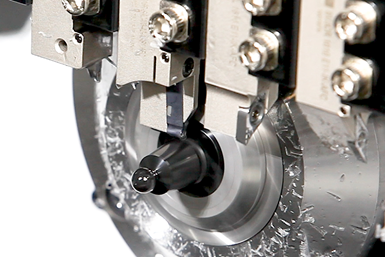
By integrating FRB's face drivers into their machining processes, manufacturers can achieve enhanced productivity, precision, and efficiency, meeting the rigorous demands of today's competitive markets. Appears in Print at Production Machining as: 'A Swift Tool Change for Swiss-Type Machines' This coolant-through tooling system replacement for the gang plate on a Swiss-type machine can save hours of spindle downtime per day as well as increase tool life and enhance chip control. While servicing the tools on a traditional platen on a sliding headstock lathe, it can take 10 minutes or more to index one insert. While indexing the tools, coolant spigots can get knocked loose by an operator and can cost a machine shop tool life and time. Once the inserts are indexed, it can take several starts and stops of the spindle for the operator to see if the coolant stream is being directed to where it needs to be.
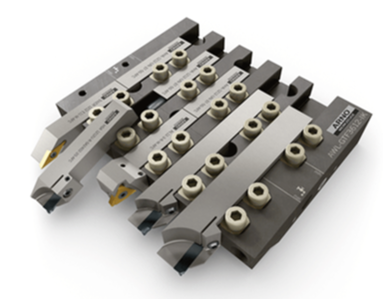
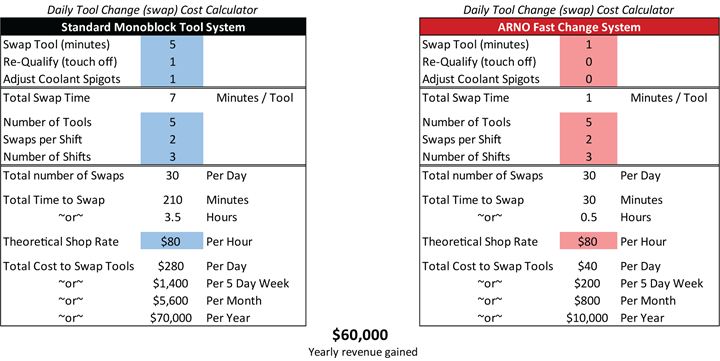
Arno’s Fast Change (AFC) tooling system consists of a gang plate that holds split-shank, coolant-through turning tools, parting tools and grooving tools. Designed like a manifold, the coolant is rerouted through the gang plate to the tools. The UN-style slot in the fixed stop picks up the coolant and runs it through the pipette to the front end where the coolant goes directly to the cutting edge. The AFC system can supply coolant to one port that supports all the tooling positions, or it can supply two ports and divide the tooling positions with the needle valve. The tooling system only needs to be plumbed once and, according to the company, after that, a high-pressure coolant line should not need to be touched again. With proper setup, the high-pressure lines are moved behind the machine guards, creating a clean machining environment. This enables operators to complete safer routine maintenance. Also, the AFC’s low-profile clamps do not collect as many chips compared with a typical clamping system. When replacing a split-shank tool, the operator simply loosens two clamps to remove the cutting head and then replaces it with a new one, the company says. Simple, Quick FunctionalityA Time and Money SaverUsing the AFC system, Arno reports that it takes 17 seconds to change a tool, a vast improvement to the typical 7 to 10 minutes it can take using a traditional gang plate. The conventional method might take five minutes to change a tool, a minute to touch the tool off and another minute to adjust the spigot, for instance.
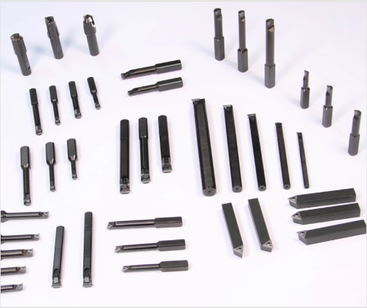
In comparison, when an operator is working with the AFC system, retouch is not necessary because the tool will repeat within plus or minus a thousandth of the previous tool positions. There is also no need to factor in time for readjusting coolant lines because the new system is a true, coolant-through system. It is also not necessary to factor in the clearing away of chips because those surfaces have mostly been eliminated with the smooth AFC design, according to Stroup. Therefore, the 17-second tool change time is the only time to factor in. But, for a real-world example, he increases the time to one minute to consider a distracted operator that might use extra seconds Although there are still 30 idle times per day, there are now only 30 minutes of downtime per day instead of 210 minutes using the traditional gang plate. “That only costs $10,000 per year, which means you’ve just made $60,000 a year on that one spindle by adopting the AFC system,” Stroup says. Arno Werkzeuge USA has reintroduced the H.B. Rouse brand of American-made carbide cutting tools and inserts. Arno Werkzeuge USA has reintroduced the H.B. Rouse brand of carbide cutting tools and inserts. Formerly sold and marketed under the Arno-Rouse name, the company has reintroduced Rouse as a standalone product offering a broad range of carbide boring bars, tools and inserts for manual turning operations. The carbide insert turning tools have triple-sided inserts for quick change turning operations. Triple-tip boring bars offer an improved triangular insert located within a precision-machined pocket to eliminate shifting under heavy cuts; the insert requires the simple removal of one screw for indexing. Boring bars feature carbide inserts that provide three cutting edges instead of only one (as is common with brazed-tip tooling). |
AuthorWe've compiled the latest news and technical information about our principals and our market that we hope you find informative! Archives
January 2026
Categories
All
|

RSS Feed